Chris Carter · October 26, 2026 · 5 min read · AI Leadership
Delegation Is a Product Decision
An agent's ability to act is not permission to act. Design the boundary between preparing a decision and making one.
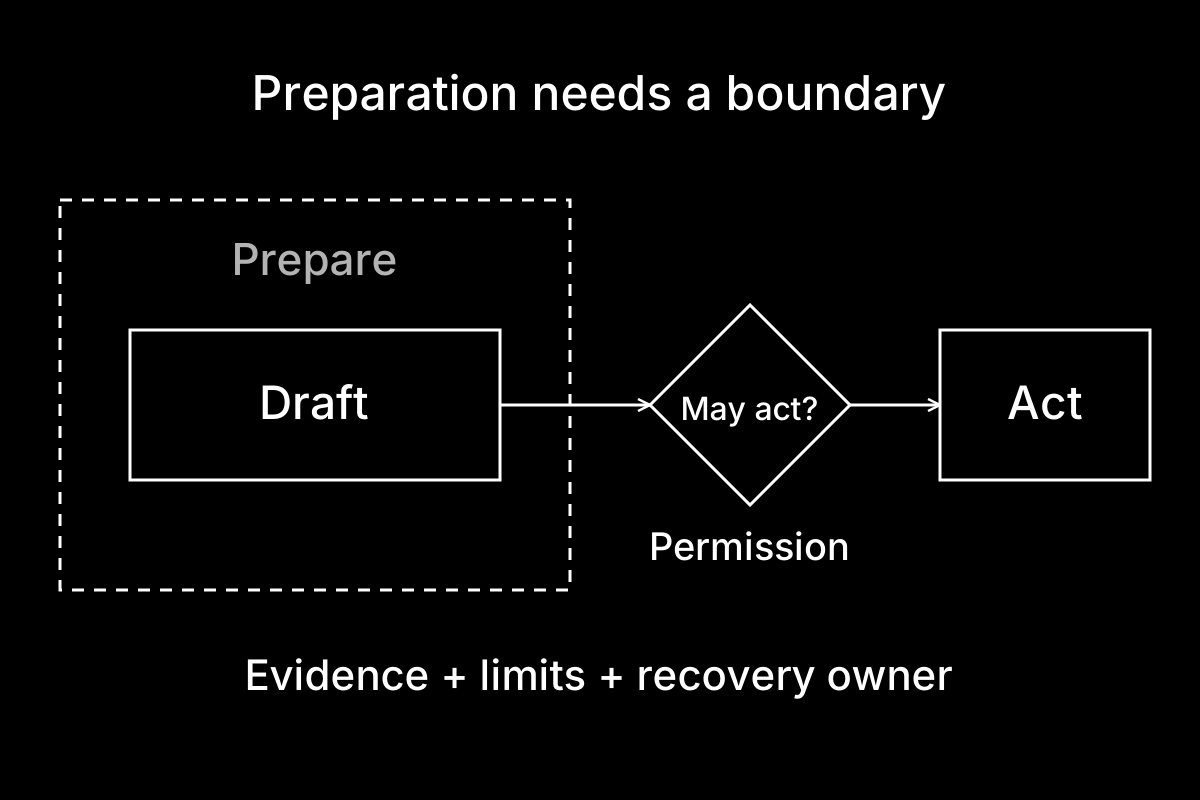
Drafting stays inside a preparation boundary. An explicit permission checkpoint separates preparation from action, with evidence and recovery responsibilities defined.
Open diagram at full sizeA conceptual model, not measured performance.
Confidence is only half the decision.
Choose an illustrative task, then change the evidence and the cost of being wrong. Watch the delegation boundary change.
Use the arrow keys to adjust each control.
Delegate within a boundary.
A reversible, well-evaluated task can be a candidate for bounded automation. Keep an undo path, clear limits, monitoring, and a named operational owner.
Act within limits. Make undo obvious.
Illustrative scenarios and qualitative rules, not model performance data or a validated risk assessment. Real release decisions also depend on domain, permissions, privacy, and operational controls.
Change the consequence, not just the confidence.
The explorer above deliberately holds the model out of view. Move the evidence and reversibility controls instead. The same apparent quality can support a useful draft but still be insufficient for a consequential commitment. A task with weak evidence should stay in evaluation; a costly mistake may need a checkpoint even when the evidence is stronger.
These are qualitative prompts for a review, not calibrated thresholds. A reply may be impossible to take back once sent. A routed request may expose confidential information. A software change may be technically reversible while its effects on people are not. Classify the real consequence, not the comforting name of the task.
Make the checkpoint a real decision.
A confirmation button is not enough. The person needs to see what will happen, why it was proposed, which evidence supports it, and what remains uncertain. They also need the authority and practical ability to reject or change the action. Otherwise the interface adds ceremony without adding control.
The leadership tradeoff is not simply speed versus caution. It is where to spend scarce human attention. Keep low-value repetition out of the review queue, but do not automate away the point where an accountable person must accept a consequence. Design preparation to make that moment faster and clearer.
Delegation expires when its assumptions do.
A bounded release needs an owner after the launch meeting. Changes to source quality, permissions, user behavior, or the underlying workflow can invalidate yesterday's decision. Write down which signals trigger a pause or a narrower scope, and who can act on them.
The useful artifact is a delegation contract, not a permanent autonomy label. It connects a specific action to evidence, authority, limits, and recovery. That gives a team something to inspect when it proposes doing more, and something to fall back to when the system should do less.
The delegation contract
- 01Name one action and its affected person or system. Separate preparation from execution.
- 02Specify the authority required. Missing permission is a stop condition, not a low-confidence score.
- 03Describe the evidence for this task, including representative failures and the limits of the evaluation.
- 04Choose the boundary: observe, recommend, confirm, or act within explicit limits.
- 05Name the operational owner, correction path, stop condition, and recovery responsibility.
Implement fast
- Take one proposed agent action and write its delegation contract before expanding its permissions.
- Walk through a plausible wrong action with the person who would have to recover from it.
- Test the checkpoint and recovery path, not only the successful automation.
Sources and further reading
More articles
All articles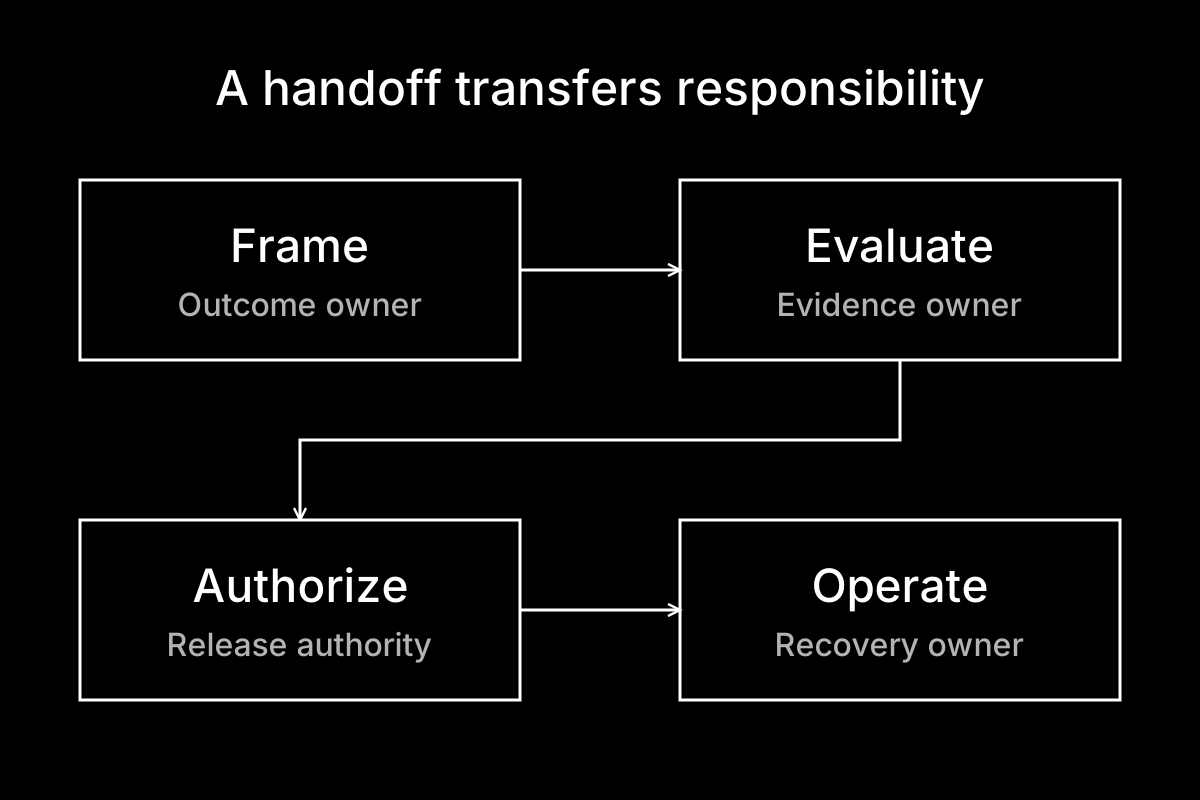
Product Leadership
October 26, 2026
5 min read
A Launch Needs an Owner, Not Another Meeting
Alignment becomes useful when it changes a decision. Connect the problem, evidence, release authority, and operating responsibility before calling a team ready.
Read the essay and explore the idea
Design Leadership
October 26, 2026
5 min read
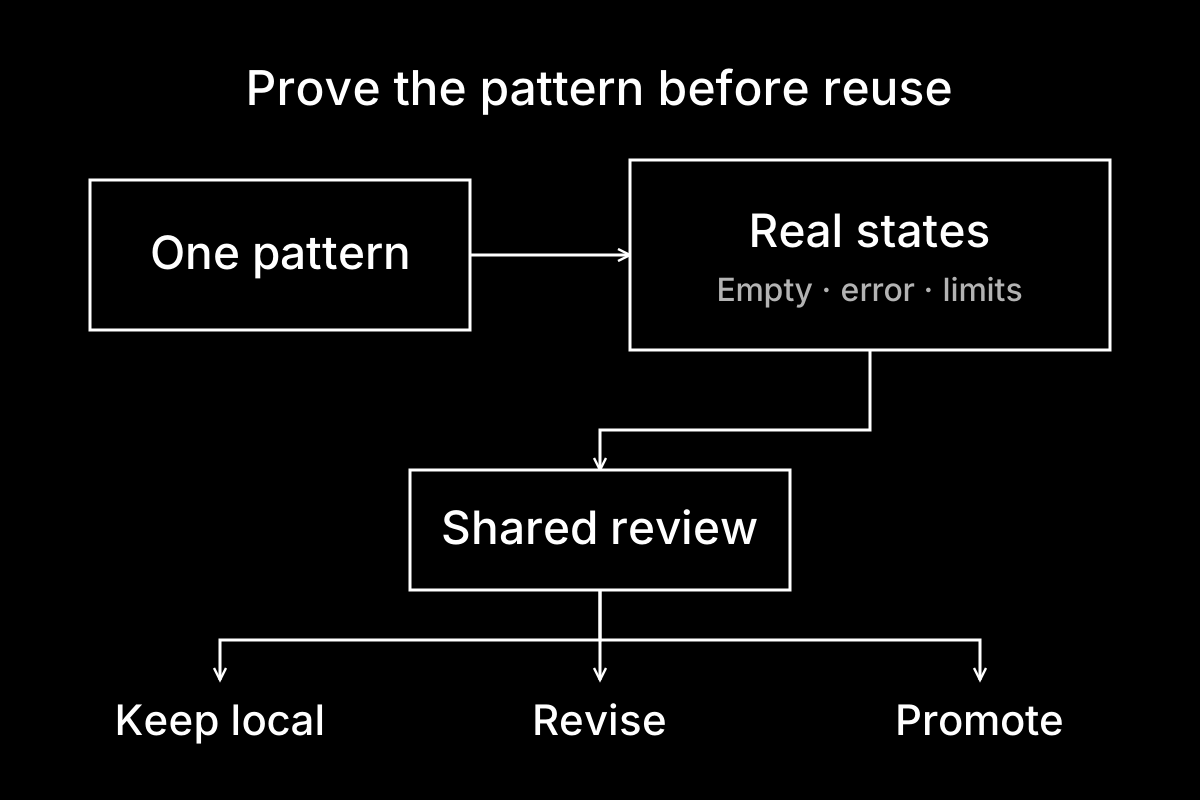
A Design System Needs Evidence Before Scale
Consistency is not enough. Before multiplying a pattern across a product, prove that it survives real states, real constraints, and shared review.
Read the essay and explore the idea
AI Design Systems
May 21, 2026
12 min read
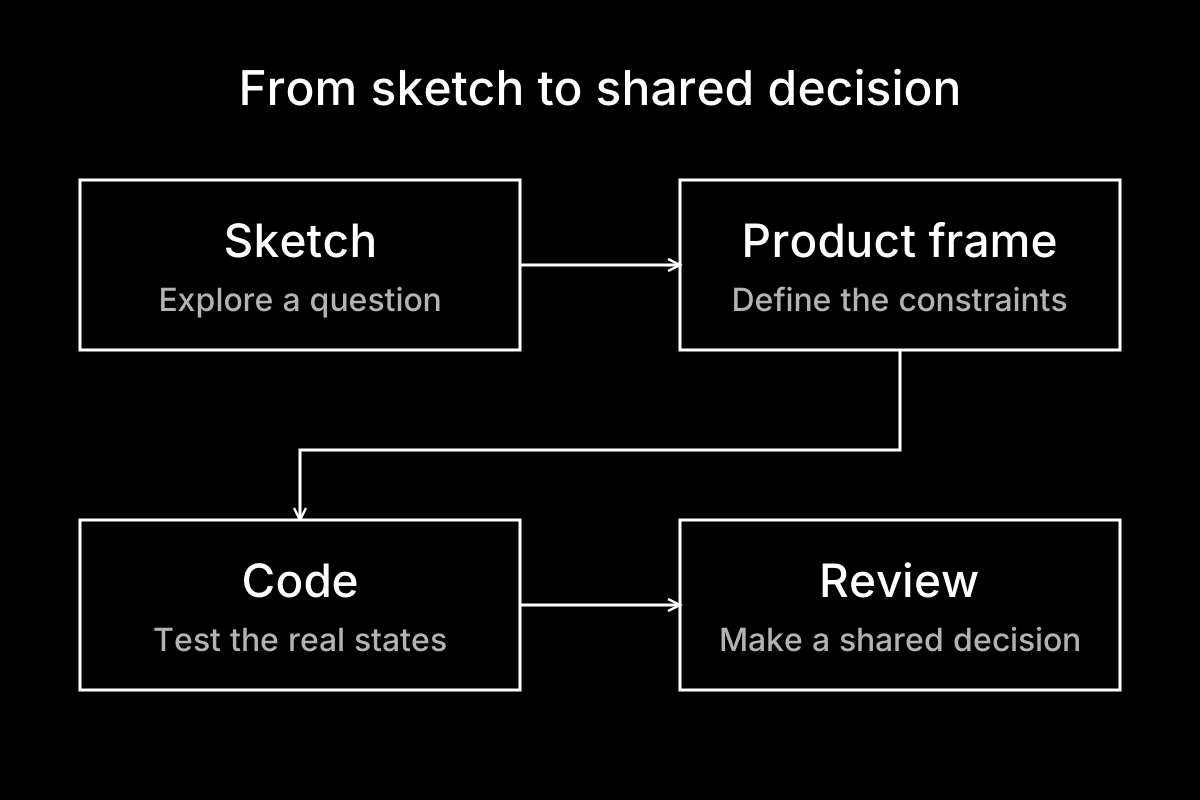
Use Figma as the Napkin, Not the Finish Line
AI can generate a screen, but production-minded design starts when the work moves into coded systems, scenario data, review paths, and pull requests.
Read the essay and explore the idea