Write a delegation contract
Before an agent acts, make its authority, limits, and recovery path explicit.
Chris Carter1 min readAI product
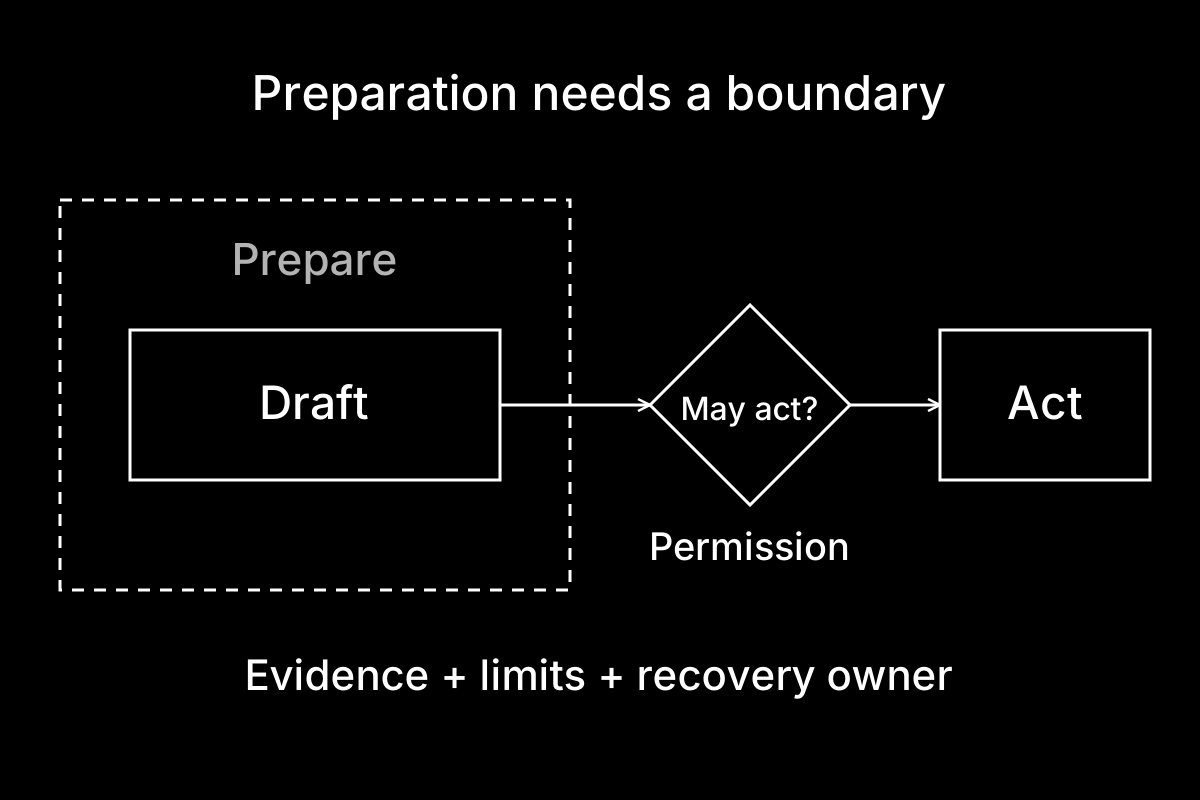
Drafting stays inside a preparation boundary. An explicit permission checkpoint separates preparation from action, with evidence and recovery responsibilities defined.
Open diagram at full sizeBeing able to prepare an action does not establish permission to execute it. A useful delegation contract separates those decisions and gives the team something concrete to review when the scope changes.
Keep the contract specific to one action. Broad labels such as 'autonomous assistant' hide the differences between drafting a reply, choosing a recipient, and sending it.
Put it to work
- Name the action and the person or system it affects.
- Record who grants permission and what remains outside that permission.
- List the evidence for this task, including known failure cases.
- Choose the boundary: observe, recommend, ask for confirmation, or act within explicit limits.
- Name the owner, stop condition, correction path, and recovery responsibility.
Hypothetical example: an assistant may draft a customer reply using an approved source. Sending still requires a named reviewer to check the recipient, evidence, and proposed commitment.
Read the full essay
This note is adapted from “Delegation Is a Product Decision.” The essay develops the argument, includes an interactive framework, and links to further reading.