Record why an AI answer was overridden
The reason for a correction is more useful than a count of corrections alone.
Chris Carter1 min readHuman review
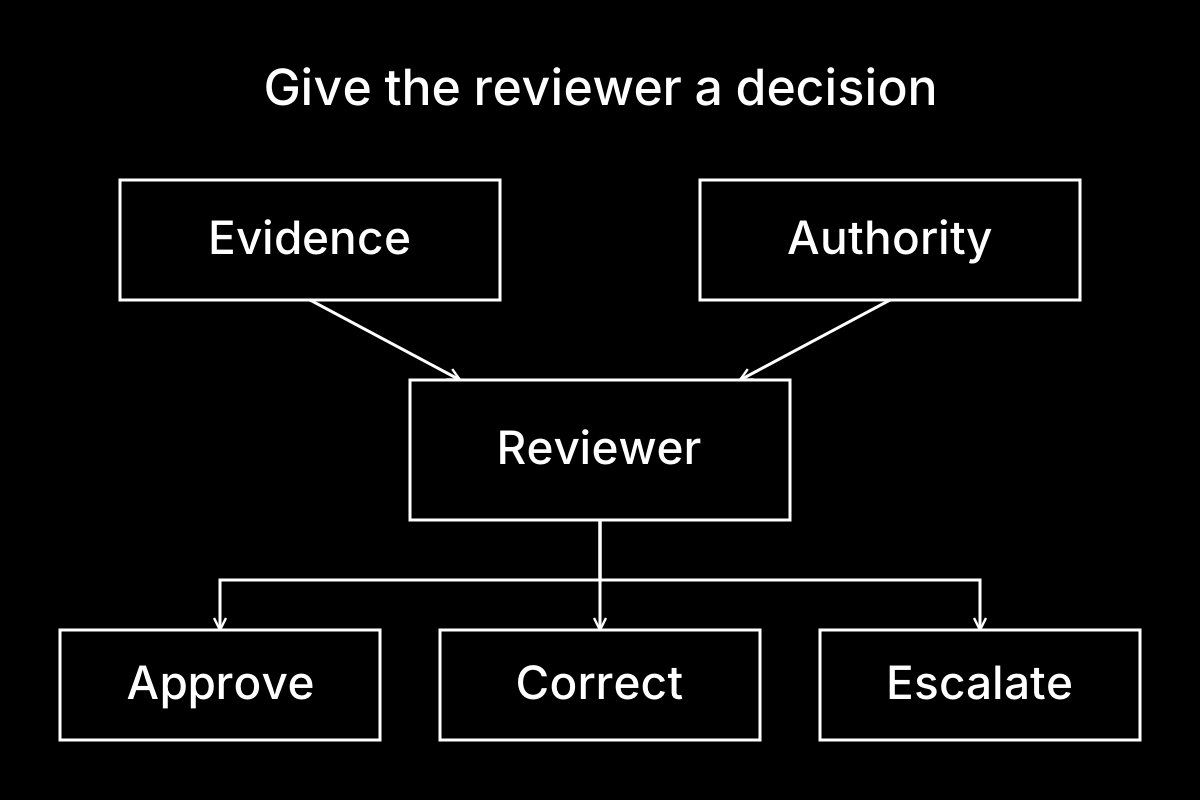
Evidence and authority meet at the reviewer. The reviewer can approve, correct, or escalate instead of merely accepting an automated answer.
Open diagram at full sizeAn override says something went wrong. Its reason helps identify what needs to change. A stale source, an unclear policy, and a misunderstood request may produce similar corrections while needing different fixes.
Keep the feedback close to the review task. Capture enough context to investigate using approved records, without copying private information into a public note or unnecessary secondary system.
Put it to work
- Define the reviewer's job: approve, reject, correct, escalate, or audit.
- Offer reason categories such as stale source, missing evidence, policy ambiguity, misunderstood intent, and unsuitable workflow.
- Allow a reviewer to explain a case that does not fit the categories.
- Review recurring reasons with the relevant product, policy, or engineering owner.
- Turn a recurring issue into a specific change and an evaluation case that checks whether it improved.
Read the full essay
This note is adapted from “Human in the Loop Is Not Safety by Itself.” The essay develops the argument, includes an interactive framework, and links to further reading.