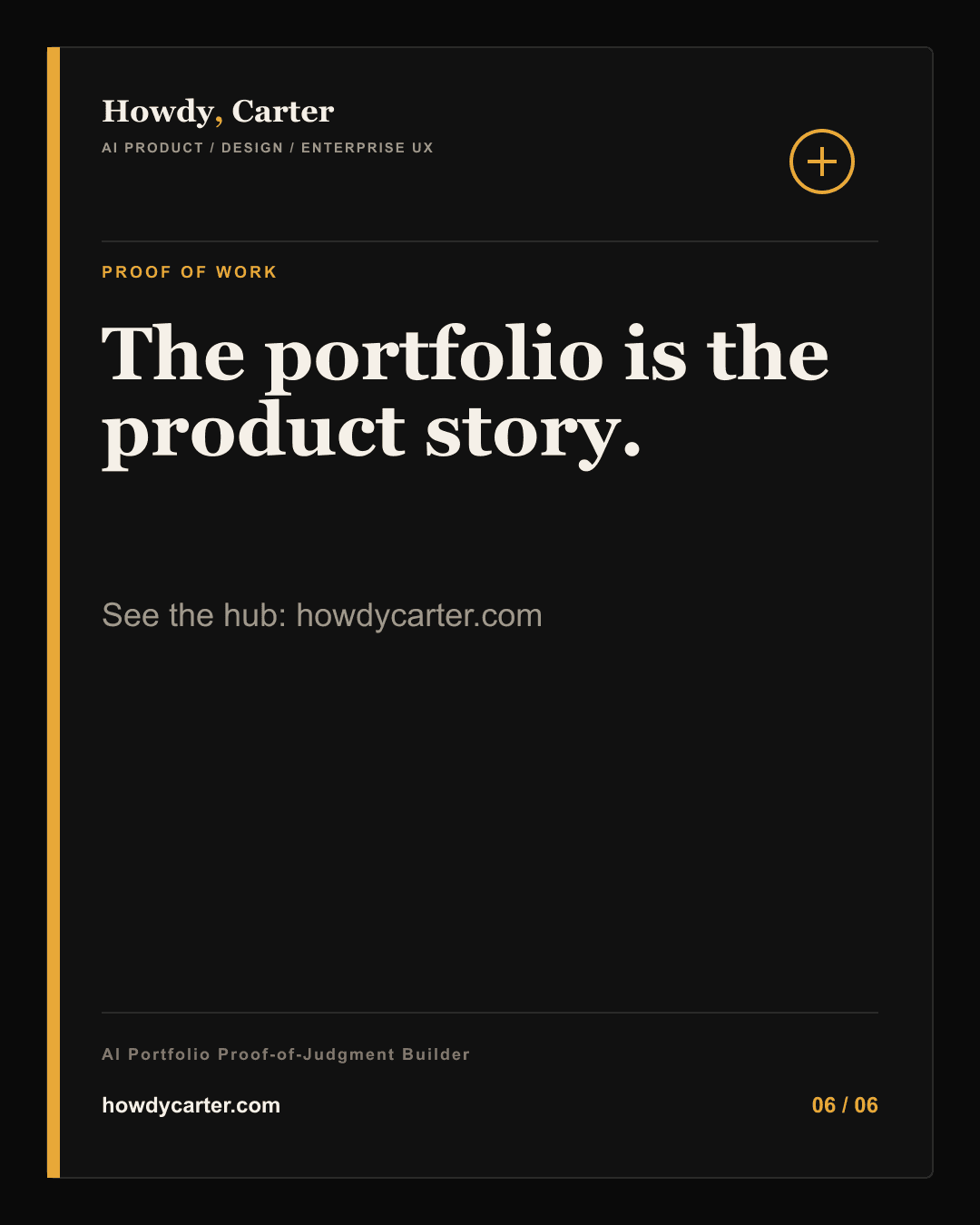
The Best AI Portfolio Is Proof of Judgment
Screenshots are not enough when the most valuable AI work is deciding what to trust, test, ship, reject, and improve.
Reusable artifact
AI Portfolio Proof-of-Judgment Builder
- 01Write the problem and the constraint.
- 02Show what you noticed that others missed.
- 03Explain what you tested and what failed.
- 04Name the tradeoff you made and why.
- 05Show how the shipped work earned trust.
Implement fast
- Choose one existing case study.
- Add a decision log section.
- Add a failure-mode section.
- Add one artifact that proves judgment: eval, source map, prototype, metric, or operating model.
AI work has too many invisible decisions.
A traditional portfolio can often get away with showing polished screens, process snapshots, and business impact. AI work needs more. The most valuable decisions are often invisible in the interface: what source to trust, what action to block, when to ask for review, what to measure, what to refuse, and what not to build yet.
That is why the best AI portfolio is proof of judgment. It should show what you noticed, what you tried, what failed, what changed, and why the shipped thing earned trust.
New model capability raises the portfolio bar.
As models become better at generating polished artifacts, polished artifacts become weaker evidence of skill. A deck, prototype, or interface is easier to produce than it used to be. Judgment is harder to fake.
If GPT-5.5 and similar systems make complex work faster, the human differentiator becomes choosing the right work, framing the right constraints, designing the review system, and knowing when the output is not good enough. A strong portfolio should make those decisions visible.
Show the trail, not just the result.
A useful AI case study should include the problem, assumptions, constraints, options, decision, risk, evidence, result, and next learning. That trail tells a hiring manager, executive, founder, or collaborator how you think under uncertainty.
Screenshots still matter. They help people see the shape of the work. But screenshots should not be the evidence by themselves. Pair them with eval sets, source maps, failure reviews, journey maps, control points, operating models, and the moments where you chose not to ship something because the product had not earned trust.
Turn every project into reusable proof.
The best public work compounds. A case study becomes an article. An article becomes a carousel. A carousel becomes a worksheet. A worksheet becomes a consulting asset, workshop, or product principle. This is how thought leadership becomes more than posting.
For me, Howdy, Carter is the proof-of-work hub for that system: AI product judgment, enterprise UX, design leadership, and building in public. The goal is not content volume. The goal is reusable evidence.
Social carousel
The shareable artifact